Changes in School Life.
Once you move from US to India, there are many evident changes that will take place in daily school routine. This includes transport, uniform, food, classrooms, books, teachers, and exams.
Transport:
There isn't too much of a change here. In the US, I would carpool with my friends to go to school, while in India I took the school bus, but some students preferred personal transport by car. So the choice is yours. Take the bus and pay for bus fees, or come on your own. The time it takes depends on the distance from school, but expect some traffic on the way.
Uniform:
Nearly all schools in India require uniforms. If you went to a public school in US, then you probably didn't have to wear uniforms. You're expected to wear a shirt and trousers/skirt, belt, tie, school shoes and socks, and an identity card on regular days, sports uniform on days with physical education, and a blazer once a week for school assemblies or other important days. Uniforms aren't much of a problem, as long as you're comfortable with it.
Food:
In the US, you either brought lunch from home, or bought it at school on a daily basis. In India, you can bring your own lunch, or eat school food, which you eat everyday, and pay a yearly fee for it. Some schools also provide breakfast. The major change of course, is the food itself. It depends on which school you go to, but there's usually chapathi, rice, sambar, and other items. The quality is solely based on the school, and you may not like it, but you'll eventually get used to it. After all, you can't expect a 5 star meal everyday.
Classrooms:
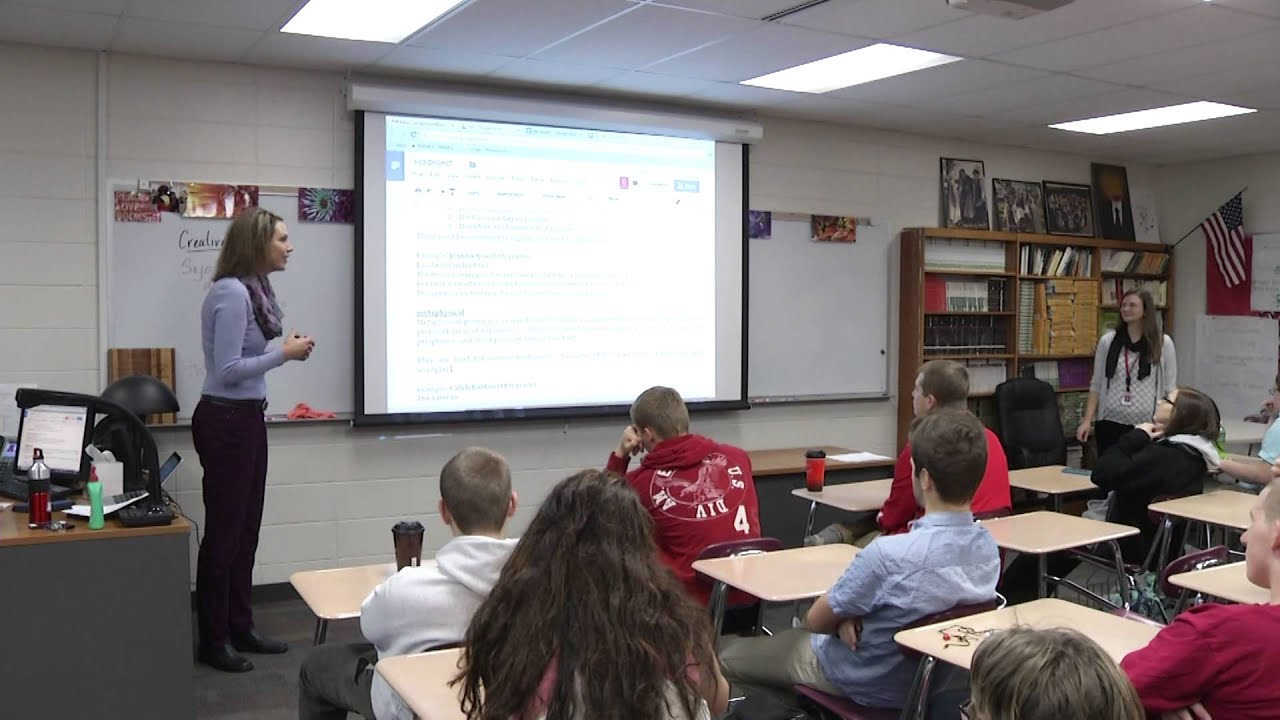
I found this to be a major change when I came to India. The schools I went to in America didn't even have a chalkboard; the teacher used a laptop and a projector. So seeing the teachers teach on a chalkboard in India seemed somewhat primitive to me at first, but it doesn't mean the teaching is any worse. The classrooms do seem a little bit uninviting as compared to American classrooms, but this depends on the school. Usually the more you pay, the better the classroom, but still, the best classrooms in India will probably be only as good as typical American classrooms. And usually, the number of students in a classroom in India is larger than in US; some schools have classes going up to 60 students, but in most schools, class size is 30 students.
Typical American Classroom: Typical Indian classroom:

Books:
The number of books in India may be a little higher and gets larger progressively, but the is also true for American textbooks. I felt that the main difference was content. The general opinion is that American books seem easier to read and are more colorful. The material seems more interesting than the black and white Indian books. But this isn't always the case. Some topics in India are more advanced and if you have an interest in them, you can do better in that subject. But in all, the Indian books do feel a little lifeless.
Teachers:
You can find every type of teacher in India. Teachers who are good at teaching, teachers who aren't, nice teachers, strict teachers, interactive teachers, boring teachers, teachers fluent in English, teachers who aren't, teachers who care about each and every student, and teachers who don't really bother. It's pretty much the same in all schools, even in the US. However, the main difference between American and Indian teachers, is the teaching method. Most teachers I had in the US closely monitored each students performance, and the way they taught, especially in elementary, was pretty fun. Although some teachers I had in India were like that, there were others that simply dictated whatever there was in the textbook. But it really wasn't their fault because the exam paper questions are different in India, as I've covered in the next topic, and so the teachers had to teach in such a way.
Exams:
It seems that everything revolves around exams in school. Generally, there are four major exams a year, excluding the minor class tests. The major exams results are what they put in the report card, but the most important is the final.
The exam questions will be different from those in America. First of all, most questions are subjective, meaning you have to write your answers in sentences, rather than multiple choice questions. Entrance exams during 12th grade use MCQ's but other than those, all Board exams are subjective. Therefore handwriting does play a part: the neater your paper, the easier it is for the teacher to read.
The questions are usually a little different, focusing on facts and keywords rather than using your own perspective. For example, American questions fro English Literature may be something like "What tone is the author writing in, and why do you think he/she is writing in that tone?" The question requires you to think on your own, and form your own type of answer. In India, the questions are like this: "Where and when does the given scene take place?" or "Explain the meaning of the following words/phrases." Teachers will usually look for keywords in your answer, and if those aren't there, they will cut marks. So remembering keywords is important.
In America, the grading system was in terms of A's, B's C's, etc. In India, there are two ways of grading, based on your Board.
ICSE - Percentage wise. You get a score out of 100 in each subject, and an overall percentage which is the average of the subject scores. For example, a 98.25%. This was the Grading System in my school.

CBSE -
IGCSE -
IB -
Transport:
There isn't too much of a change here. In the US, I would carpool with my friends to go to school, while in India I took the school bus, but some students preferred personal transport by car. So the choice is yours. Take the bus and pay for bus fees, or come on your own. The time it takes depends on the distance from school, but expect some traffic on the way.
Uniform:
Nearly all schools in India require uniforms. If you went to a public school in US, then you probably didn't have to wear uniforms. You're expected to wear a shirt and trousers/skirt, belt, tie, school shoes and socks, and an identity card on regular days, sports uniform on days with physical education, and a blazer once a week for school assemblies or other important days. Uniforms aren't much of a problem, as long as you're comfortable with it.
Food:
In the US, you either brought lunch from home, or bought it at school on a daily basis. In India, you can bring your own lunch, or eat school food, which you eat everyday, and pay a yearly fee for it. Some schools also provide breakfast. The major change of course, is the food itself. It depends on which school you go to, but there's usually chapathi, rice, sambar, and other items. The quality is solely based on the school, and you may not like it, but you'll eventually get used to it. After all, you can't expect a 5 star meal everyday.
Classrooms:
I found this to be a major change when I came to India. The schools I went to in America didn't even have a chalkboard; the teacher used a laptop and a projector. So seeing the teachers teach on a chalkboard in India seemed somewhat primitive to me at first, but it doesn't mean the teaching is any worse. The classrooms do seem a little bit uninviting as compared to American classrooms, but this depends on the school. Usually the more you pay, the better the classroom, but still, the best classrooms in India will probably be only as good as typical American classrooms. And usually, the number of students in a classroom in India is larger than in US; some schools have classes going up to 60 students, but in most schools, class size is 30 students.
Typical American Classroom: Typical Indian classroom:
Books:
The number of books in India may be a little higher and gets larger progressively, but the is also true for American textbooks. I felt that the main difference was content. The general opinion is that American books seem easier to read and are more colorful. The material seems more interesting than the black and white Indian books. But this isn't always the case. Some topics in India are more advanced and if you have an interest in them, you can do better in that subject. But in all, the Indian books do feel a little lifeless.
Teachers:
You can find every type of teacher in India. Teachers who are good at teaching, teachers who aren't, nice teachers, strict teachers, interactive teachers, boring teachers, teachers fluent in English, teachers who aren't, teachers who care about each and every student, and teachers who don't really bother. It's pretty much the same in all schools, even in the US. However, the main difference between American and Indian teachers, is the teaching method. Most teachers I had in the US closely monitored each students performance, and the way they taught, especially in elementary, was pretty fun. Although some teachers I had in India were like that, there were others that simply dictated whatever there was in the textbook. But it really wasn't their fault because the exam paper questions are different in India, as I've covered in the next topic, and so the teachers had to teach in such a way.
Exams:
It seems that everything revolves around exams in school. Generally, there are four major exams a year, excluding the minor class tests. The major exams results are what they put in the report card, but the most important is the final.
The exam questions will be different from those in America. First of all, most questions are subjective, meaning you have to write your answers in sentences, rather than multiple choice questions. Entrance exams during 12th grade use MCQ's but other than those, all Board exams are subjective. Therefore handwriting does play a part: the neater your paper, the easier it is for the teacher to read.
The questions are usually a little different, focusing on facts and keywords rather than using your own perspective. For example, American questions fro English Literature may be something like "What tone is the author writing in, and why do you think he/she is writing in that tone?" The question requires you to think on your own, and form your own type of answer. In India, the questions are like this: "Where and when does the given scene take place?" or "Explain the meaning of the following words/phrases." Teachers will usually look for keywords in your answer, and if those aren't there, they will cut marks. So remembering keywords is important.
In America, the grading system was in terms of A's, B's C's, etc. In India, there are two ways of grading, based on your Board.
ICSE - Percentage wise. You get a score out of 100 in each subject, and an overall percentage which is the average of the subject scores. For example, a 98.25%. This was the Grading System in my school.

CBSE -
Grade Point
|
Grade
|
Equivalent GPA
|
10.0
|
A1
|
91 – 100
|
9.0
|
A2
|
81 – 90
|
8.0
|
B1
|
71 – 80
|
7.0
|
B2
|
61 – 70
|
6.0
|
C1
|
51 – 60
|
5.0
|
C2
|
41 – 50
|
4.0
|
D
|
33 – 40
|
-
|
E1
|
21 – 32
|
-
|
E2
|
20 and below
|
IGCSE -
IGCSE Grade
|
US Grade
|
Equivalent GPA
|
A*
|
A or N/A
|
4.0 or 4.3(Weigthed)
|
A
|
A
|
4.0
|
B
|
A-
|
3.7
|
C
|
B
|
3.0
|
D
|
C+
|
2.3
|
E
|
C
|
2.0
|
F
|
D+
|
1.3
|
G
|
D
|
1.0
|
U
|
E/F
|
0.0 (IGCSE Ungraded)
|
IB -
Grade
|
Percentage Conversion
|
7
|
97 – 100%
|
6
|
93 – 96%
|
5
|
84 – 92%
|
4
|
72 – 83%
|
3
|
61 – 71%
|
2
|
50 – 60%
|
1
|
Less than 50%
|


